

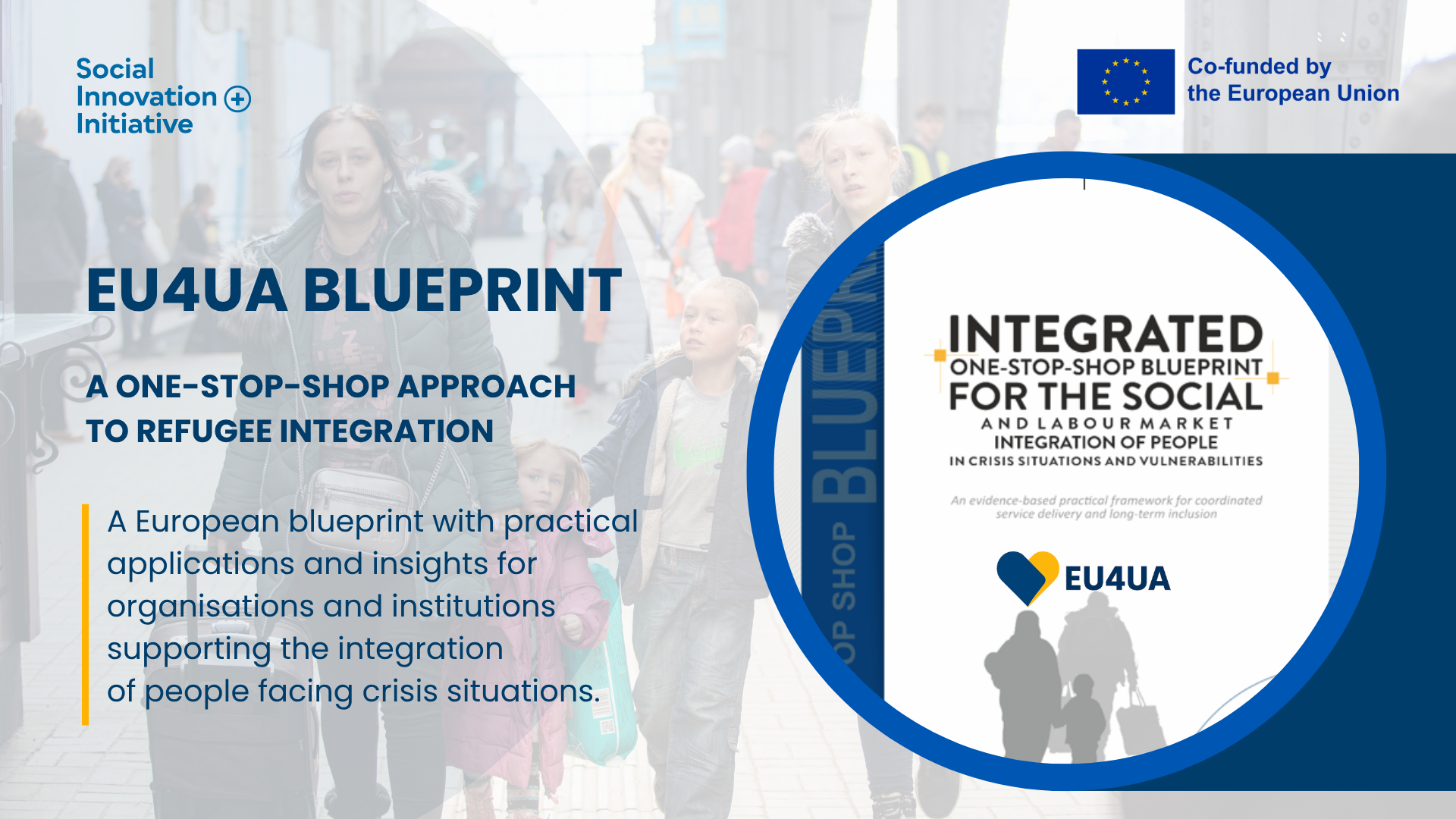
Lessons from Romania and Poland on moving from fragmented services to support organised around the person
When a person displaced by war asks for help finding a job, employment may be only one part of the problem. Childcare, language, transport, housing, health, legal documentation or family circumstances may all affect whether that person can actually take the next step. Yet each need may sit with a different organisation, programme or public service.
For people seeking support, this can mean repeating the same story several times, receiving contact details for another service without knowing what happens next, or trying to coordinate institutions that do not always coordinate with one another. The system may make sense from the perspective of each provider, but not from the perspective of the person navigating it.
This was one of the central challenges explored by EU4UA, an 18-month European project that brought together organisations in Romania and Poland to research, develop, test and refine a one-stop support model for Ukrainian refugees. The project asked a practical question: how can services work together around a person’s situation rather than leaving that person to connect the system alone?
The answer is not to place every service under one roof.
The EU4UA pilot suggests something more useful: create a clear pathway from understanding a person’s situation to agreeing priorities, connecting the right support, following progress and checking whether the expected outcome was achieved.
The coordination gap is often experienced by the person
The EU4UA model was informed by research in Poland and Romania, including a survey of 238 Ukrainian refugees, 21 interviews with service providers and four refugee focus groups. The Blueprint was then tested under real-life service conditions with Ukrainian participants and professionals working in migrant and refugee support.
Across that work, a broader pattern emerged: people’s needs are rarely isolated. A language barrier can affect employment. Housing instability can make training difficult. A health issue can interrupt a job search. Childcare can determine whether a parent can attend a course or accept a job. Legal status can affect access to several other services.
When services respond only to the issue presented at the first meeting, they can miss the factors that prevent progress. A more comprehensive assessment helps practitioners see the links between different areas of a person’s life and decide which steps need to happen first.
But assessment is only useful if it leads to action. The pilot showed the importance of moving from identifying needs to setting priorities, agreeing an action plan, providing support or making an effective referral, following up and checking the result.
Three lessons for organisations supporting people displaced by crisis
1. Referral is not the same as coordination
Giving someone the phone number, website or address of another organisation may be necessary, but it does not guarantee access. The person may still face language barriers, unclear eligibility rules, long waiting times or uncertainty about whom to contact. They may arrive at the next service only to discover that important information has not travelled with them.
The EU4UA pilot highlighted a stronger approach to referrals. Organisations need clarity about who takes responsibility for the next step, what information can and should be transferred, how the receiving service confirms the referral and whether the person actually reaches the support they need.
This changes coordination from a list of organisations into a working pathway. For humanitarian and civil society actors, that distinction matters. A service directory tells people what exists. A coordinated pathway helps them move through it.
2. Tools should strengthen professional judgement, not replace it
Standardised tools can improve consistency. They can help practitioners ask questions that might otherwise be missed, document priorities and follow progress. Yet people’s situations do not fit neatly into forms.
During the EU4UA pilot, practitioners repeatedly adapted tools to the person and context in front of them. That was not a weakness of the model. It was an important finding. Effective support requires enough structure to create continuity and enough flexibility for professional judgement.
For organisations designing services, this means resisting two extremes. One is an entirely informal process that depends on individual staff members and becomes difficult to reproduce. The other is a rigid procedure that turns the person into a sequence of boxes to be completed. Good tools sit between the two.
3. A common model must still adapt to local reality
Romania and Poland offered different institutional structures, legal frameworks, service ecosystems and local capacities. The pilot confirmed that a one-stop model cannot simply be copied from one city or country to another.
What can travel is the operational logic: start with the person’s situation, assess needs comprehensively, agree priorities, coordinate support, make accountable referrals, follow progress and focus on outcomes. The organisations involved, the services available and the way responsibilities are shared must then be adapted to local conditions.
This is especially relevant beyond the Ukrainian response. Humanitarian actors frequently work in contexts where services are distributed among public authorities, NGOs, community organisations, employment services, healthcare providers and other actors. A shared coordination logic can help connect those resources without pretending that every context has the same infrastructure.
From counting activities to asking what changed
The pilot also raised a wider question about how support is measured. Humanitarian and social programmes often report what is easiest to count: consultations delivered, referrals made, training sessions completed or people reached.
These figures matter, but they do not tell us whether the pathway worked. Did the person access the service they were referred to? Did the training improve their chances of employment? Was a health or legal barrier resolved? Did the combination of services help the person move toward the goal they had identified?
A one-stop approach shifts attention from individual activities toward the journey and its outcome. It asks organisations not only what they delivered, but whether different pieces of support connected well enough to make progress possible.
That is also why coordination should not be treated as an administrative layer around service delivery. Coordination is part of the service itself. When it works, people spend less effort navigating institutions and more effort rebuilding stability, autonomy and participation in their new communities.
A practical model, not a fixed template
The final EU4UA Blueprint brings together comprehensive needs assessment, case management and the one-stop-shop principle with practical guidance on integrated support pathways, partnerships, implementation and sustainability. It covers areas such as employment guidance, vocational training, language learning, legal support, healthcare and psychosocial support.
Its value is not in prescribing one institutional structure. The aim is to offer a common operational core that organisations and public institutions can adapt to their own systems while keeping the person and their individual pathway at the centre.
The experience from Romania and Poland points to a simple but demanding idea: people should not have to become experts in our organisational structures in order to receive support.
For organisations responding to displacement and other complex crises, the next step may not always be creating another service. Sometimes it is making the existing services work together more clearly, with shared responsibility for what happens between the first request for help and the outcome a person is trying to reach.
Resource
Explore the EU4UA Blueprint: eu4uablueprint.org
The project “EU4UA: A Comprehensive One-Stop Service for Refugees!” is implemented by PCG Polska (coordinator) in partnership with FISE, ADV Romania, Bethany Social Services Foundation. The project is co-funded by the European Union under the European Social Fund Plus Social Innovation+ initiative. The views and opinions expressed are those of the authors and do not necessarily reflect those of the European Union or the European Social Fund Agency. Neither the European Union nor the granting authority can be held responsible for them.

Leave A Comment